

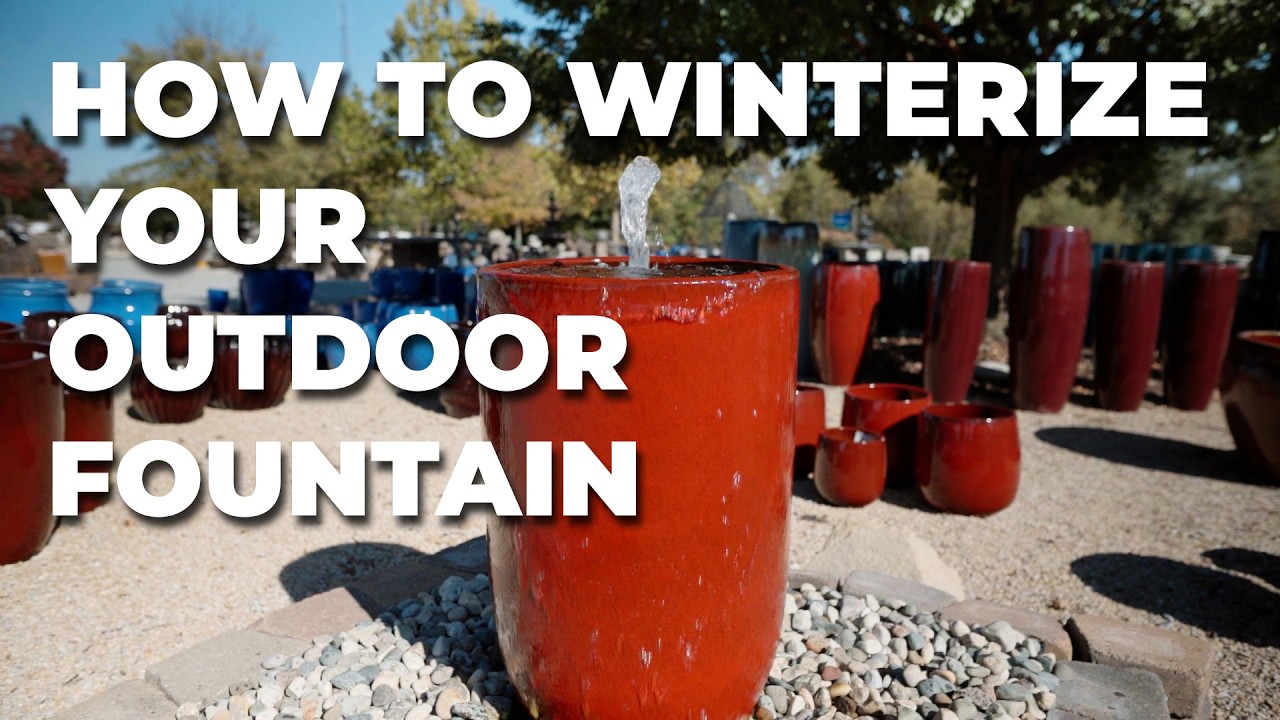
Every fall, homeowners across Greater Cincinnati ask our team when to shut down their outdoor fountains. Here’s my rule of thumb: If you’re not wearing shorts, that’s a good time to consider shutting off your water feature. And if you’re not about ready to go boating, you’re probably about ready to winterize your fountain.
Winterizing takes less effort than replacing a cracked fountain in spring. Below, I’ll walk you through how we protect cast stone fountains and pottery bubblers at Aquatic & Garden Decor. I’ll also cover the mistakes I see each spring, plus how to start your fountain back up.
When should you winterize a fountain in Cincinnati?
Winterize your fountain once the temperature starts dipping to 32 degrees and staying there. Freezing starts at 32 degrees. If water can lie in a fountain and freeze, it can damage it.
The same timing applies across our whole region. That includes Northern Kentucky, Indiana, western West Virginia and the rest of Ohio. We also see customers from Louisville, Lexington, Indianapolis and Columbus, especially in spring.
Watch the forecast rather than the calendar. Once the weather starts to clip the 32-degree mark and stay there, it’s time to put your fountain to bed. A warm late fall can buy you extra time. Some years, you can enjoy your fountain well into December.
Why are Cincinnati winters hard on fountains?
Have you ever seen a sidewalk without a crack? Cast stone is a form of concrete, which means it can crack, even when it’s reinforced. Our winters also swing between freezing nights and mild afternoons. Every swing gives water another chance to freeze and expand.
The vast majority of our cast stone carries a strength rating of 6,000 to 7,000 PSI. That’s highway bridge quality, which lessens the risk big time. Still, any concrete bridge wears down after years of freezing and thawing. Pooled water bites into the concrete and can spall or crack it.
It’s not the temperature, it’s the moisture, it’s the condensation.
Keeping the fountain covered stops moisture from grabbing onto the cement. That’s the big thing.
Trapped water can crack pottery the same way, whether it’s a container or a fountain. For pottery containers, I always suggest putting gravel bigger than the drain hole in the bottom. The gravel keeps the hole open, which lets water drain out instead of freezing and cracking the pot. Cast stone containers get the same treatment.
Does sealing protect a fountain from winter damage?
Sealing helps preserve a fountain’s stain color. A sealer won’t add one bit of tensile strength, though. It also won’t keep pottery or cast stone from expanding and contracting in the cold. With the products we sell, sealing does absolutely nothing to prevent freeze damage. A good cover is what protects your fountain.
What should you do with your fountain pump in winter?
Unplug your fountain first thing when you shut it down for the season. For a standard recirculating fountain, take the pump out too if that’s practical. Clean it and store it indoors in a container of water. The water stops the pump’s seals from drying out over winter.
Pondless water features are the exception, since that pump can stay in the ground. I’ll cover those further down.
How do you winterize a cast stone fountain?
Winterizing a cast stone fountain comes down to getting the water out and keeping it out. Here’s how we tell customers to do it.
- Empty all the water. Drain every bowl in the fountain. Remove any drain plugs or grommets so leftover water can escape.
- Add towels or burlap. Tuck them into any area that can hold water. They soak up condensation under the cover, kind of like a diaper.
- Put on a fountain cover. Our winter fountain covers are conical in shape, with a pull string grommet at the bottom.
- Tighten the top and bottom. Cinch the pull string snug around the base. Gather any extra material at the top and tie it into a ponytail. Taut sides shed water instead of letting it pool.
- Check it now and then. Look for sagging spots or collected water through the winter. Otherwise, once you cover it, just don’t touch it. Let it go.
How should a fountain cover fit?
A fountain cover works like a tent. It needs a high point at the top center so rain and snow slide off the sides. Our covers are water resistant but not fully waterproof. That’s why fit matters.
Some fountains lack a natural high spot, especially once you remove a top piece. In that case, prop up the center with an object to hold the cone shape.
The cover should fit snugly, with no sagging spots where water can pool. A tight cover also prevents a sail effect, where wind catches loose material and can knock the fountain over.
We carry fountain covers in a variety of sizes. Since inventory changes through the season, call ahead if you need a specific size. Bring your fountain’s measurements when you visit. Our team will help you find the right fit.
How do you winterize a pottery bubbler or pondless water feature?
In a pondless water feature, water bubbles up through a piece of pottery or basalt and disappears into gravel. From the outside, it looks like there’s no pond at all.
For a pottery bubbler, empty the water out of the pottery piece. Next, bottle cap the top with a piece of pond liner, which we sell in the showroom. The liner prevents water from collecting inside the pottery, freezing and cracking it.
You can leave the rest alone. For pondless systems purchased from us, the tub and pump in the ground can withstand freezing and thawing. You don’t have to take the pump out. It’s going to rain, sleet and snow a thousand times. Even if you empty the tub, it’s going to refill.
Which fountains need the least winter care?
Our basalt, onyx, petrified bamboo and marble water features need the least winter care. To me, they’re the absolute diamond of all diamonds. Turn the feature off and unplug it. That’s all it needs, with no cover required.
Can you bring a small fountain inside for winter?
Smaller fountains give you more options. You can flip the bowls upside down so they can’t hold water. Storing the whole fountain in a garage or shed works too. If your fountain doesn’t splash, bring it indoors and enjoy it all winter.
What causes winter damage to outdoor fountains?
By far, the damage I see each spring comes from fountains that never got covered. If you don’t cover cast stone or pottery, more than likely you’re going to have damage. Watch for these other mistakes, too.
- Using a garbage bag. Garbage bags are the absolute worst to use. Cheap plastic sags, which lets water pool and freeze on top. The conical winter covers we carry are flat out the best thing to use because they divert water straight off.
- Leaving a fountain with bowls assembled and uncovered. Rain and snow collect in the bowls, freeze and crack them. Skipping the drain and the cover also voids any warranty.
- Adding antifreeze. Antifreeze won’t prevent winter damage. It also voids any warranty.
- Using a heater or de-icer. De-icers help keep an opening in pond ice. In a fountain, any heating or de-icing device is off-limits over winter.
- Counting on a sealer. A sealer protects the stain color only. Your fountain still needs a cover.
We stand behind the quality of every product we sell. To help your fountain hold up through winter, winterize it with products purchased at Aquatic & Garden Decor.
How do you start a fountain back up in spring?
Spring startup reverses the winter steps.
- Pull off the cover. If you don’t uncover it, you’re never going to see it.
- Take out the towels or burlap. Remove anything else you packed into the fountain, too.
- Put the pump back. Reinstall it if you stored it indoors. Check that the fountain is still level, since an un-level fountain won’t flow properly.
- Clean the fountain. Clear out any leaves and debris that collected over winter.
- Fill it and plug it in. Fill the fountain with fresh water. Plug it in and turn it on. There you go.
How do you keep a fountain healthy all season?
A few habits help your fountain flow well from spring through fall.
- Keep the bowls full. A low water level makes the pump overheat and fail. No warranty covers pump failure from low water.
- Clear the pump intake. Leaves and debris choke the water flow that keeps the motor cool. A clogged pump can overheat. No warranty covers that failure either.
- Use an algaecide for algae. Clean the fountain and refill it with fresh water first. Our algaecides aren’t harmful to people, birds or other animals when you follow the package directions.
- Skip the chlorine bleach. Bleach corrodes the pump and fades any color on the fountain. Adding it voids the warranty on both the pump and fountain.
- Plug straight into an outlet. We don’t recommend extension cords with recirculating pumps.
- Give it a break. Shut it off overnight, while you’re at work and when you’re on vacation. A fountain left on around the clock loses more water to wind, splash and evaporation.
Where should you put a new water feature?
Spring is also a great time to add a new fountain. Start by marking out a spot and knowing your budget for space. How much room do you want it to take up in your landscape bed? Decide whether it’s for people walking by or just for you.
Generally speaking, the best value and the best utilization of a water feature is where you spend the most time. That is super key.
Where can you find fountain covers near Cincinnati?
Stop by our six-acre showroom in West Chester to see fountain covers and pond liner in person. Our team can help you pick the right cover for your fountain and walk you through winterizing it.
Ready to put your fountain to bed for the winter? Stop in early for the best selection of cover sizes. Our team will help you winterize it right. Call us at 513-777-1744 or visit us at 9390 Cincinnati-Columbus Rd.